Mid-May – Jun
Arrival and peak
Humpbacks arrive and feed hard. Snow still low on the mountains, boats not yet full, and prices at their lowest. Sea lions are already on the rocks and the puffins are coming ashore. The best value weeks of the season.
Whales
The water off Seward is a feeding ground rather than a corridor animals pass through, and that single fact changes your odds. This page is which whales are here, which months they are here in, which boat gives you the best chance, and the honest answer about guarantees.
Quick answer
An Alaska whale watching cruise out of Seward costs from $156 for four hours in Resurrection Bay and $250 for the six-hour national park cruise, which covers far more water. Humpbacks feed here from mid-May to early August and orca are seen right through the season. Nobody guarantees a sighting. Sea otters and Steller sea lions, on the other hand, are close to certain on every trip.
Why the odds here are good
A feeding ground, not a migration route. That is the whole reason the odds are what they are.
Whale watching in most of the world means intercepting animals on a migration route. You go to a place they swim past, and you hope for good timing.
The Gulf of Alaska in summer is different. Cold, nutrient-rich water upwells against the continental shelf and turns into an enormous amount of food: krill, herring, capelin, sandlance. Humpback whales come here to eat, and they stay while the food does. That is why a boat can leave Seward and reasonably expect to find one within a couple of hours.
It also explains the shape of the season. Humpbacks arrive from the middle of May, feed hard through June and July, and begin to thin out after the first week of August as they prepare to head south. September sailings still see them; they just see fewer.
Orca run on a different logic. Resident pods follow salmon and transient pods follow seals and sea lions, and both are seen through the whole season without any predictable pattern. An orca sighting will change a boat’s course immediately, and the crew will tell you plainly that it is luck.
The thing nobody puts in a listing: the crew find whales by watching birds. Gulls and kittiwakes working a patch of surface mark bait fish, and bait fish mark whales. If you want to see the first blow before it is announced, watch where the birds are.
Month by month
Three animals on three different calendars. The boats run the same season regardless.
Mid-May – Jun
Humpbacks arrive and feed hard. Snow still low on the mountains, boats not yet full, and prices at their lowest. Sea lions are already on the rocks and the puffins are coming ashore. The best value weeks of the season.
Jul
The longest days, the calmest water, and whales still feeding. Also the busiest and the first weeks to sell out. Book the full-day sailings about a week ahead.
Aug
Humpback numbers drop after the first week as animals start moving south. Bears come onto the salmon streams, the light turns golden earlier, and rain becomes more likely.
Sep
Sightings are less frequent but the fjords are almost empty of people. Weather cancels more often, and by mid-month the fleet is out of the water for the year.
Improving your odds
None of these guarantees anything. All six change the probability.
A six-hour cruise covers two or three times the water of a four-hour one and spends real time in the open Gulf where humpbacks feed. More water searched is more chances.
This is the feeding window. Outside it the animals are still around, but there are fewer of them and they are moving rather than staying.
Nothing is ever spotted properly through a salt-covered window. The crew scan from the top deck, and so should you.
Working gulls and kittiwakes mark bait fish, and bait fish mark whales. Experienced passengers are looking at the sky.
A blow lasts two seconds and often happens half a mile off. Some boats carry a few pairs; your own is better, and 8×42 is the right size for a moving deck.
Boats in this fleet tell each other where the animals are. If your captain suddenly changes course without explanation, something has been reported.
The four-hour trips see whales regularly and never reach a glacier. If you want both in one day, six hours is the minimum.
Half day or full day→What you will actually see
Backs and blows, mostly — and every so often something that stops the conversation on deck.
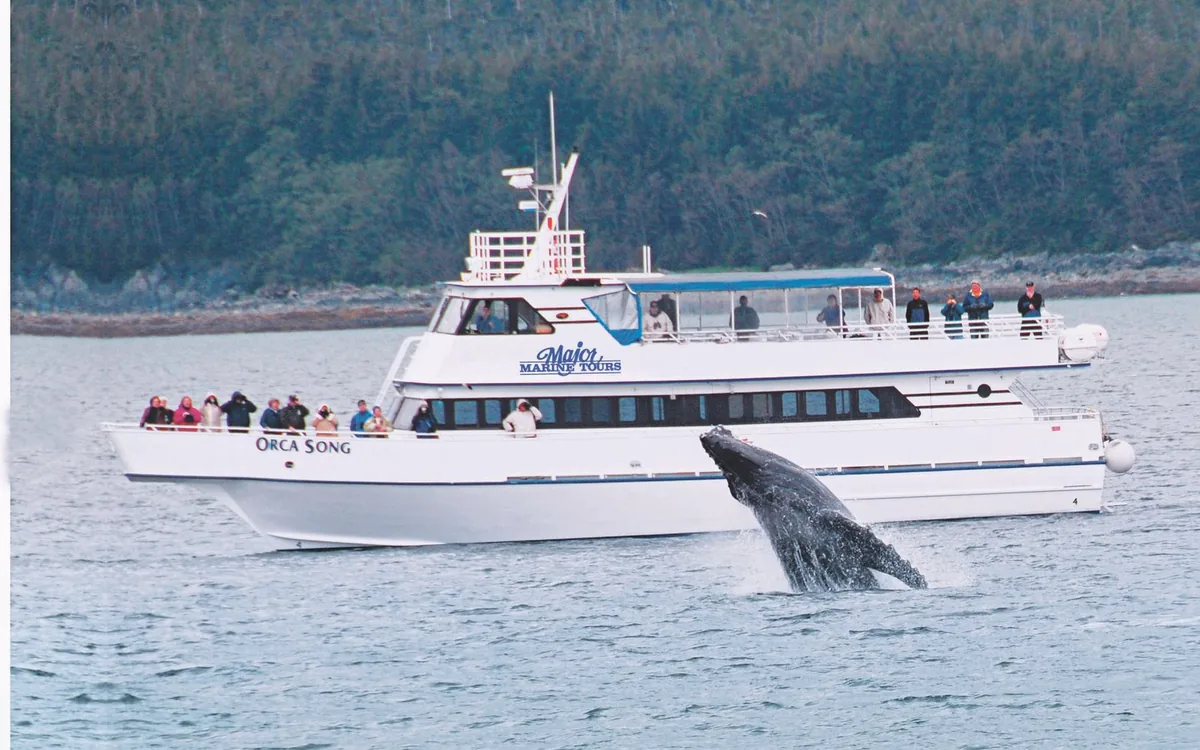
Humpback whale. Up to fifteen metres, with a tall bushy blow you can see from a long way off in still air, a long dark back, and the fluke lifted clear of the water before a deep dive. The one animal here that reliably breaches, though breaching is not the typical sighting.
Orca. Unmistakable: the dorsal fin of a mature male stands almost two metres out of the water. Seen in family groups, moving purposefully, and always the highlight of any sailing they appear on.
Dall’s porpoise. Black and white, extremely fast, and fond of riding bow waves. Often mistaken for a small orca at distance. The most energetic thing in this water.
Steller sea lion. Not a whale and impossible to ignore. Bulls weigh up to a tonne and haul out in loud, crowded rookeries on exposed rock. Seen on essentially every trip.
Sea otter. The one animal you are close to certain to see, in every month, usually floating on its back with its paws out of the water. Resurrection Bay is full of them.
Harbour seal. Hauls out on the floating ice in front of the glacier faces to pup, which is one reason boats keep their distance there.
What none of this looks like is the photograph on the listing. The typical sighting is a back and a blow two hundred metres away, and it is better than it sounds when someone is telling you what you are looking at.
Common questions
High between mid-May and early August, and no honest operator will put a number on it. Humpbacks feed in this water rather than passing through, which is why the odds are good. Sea otters and Steller sea lions are close to certain on every sailing.
June and July for humpbacks at peak feeding, with the window running from mid-May to the first week of August. Orca are seen throughout the season without a pattern.
A six-hour Kenai Fjords sailing out of Seward, because it crosses open water where the animals feed. The four-hour Resurrection Bay cruise sees them too and costs less, but it covers far less ground and never reaches ice.
Yes, through the whole season. Resident pods follow salmon and transient pods follow seals and sea lions. There is no reliable pattern and every sighting is luck.
No. This niche does not use the free-second-trip guarantee that some whale-watching regions do. What every operator here does offer is free cancellation up to 24 hours before.
Steller sea lions on the rookeries, sea otters everywhere, harbour seals on the floating ice, horned and tufted puffins from late May, bald eagles on the channel markers, and bears on the shore on the Anchorage wildlife days.
Go deeper
Fifteen departures priced per person and per hour, from $116 to $1,334.
Kenai FjordsAialik, Holgate and Northwestern — which boat reaches which face, and for how long.
VerdictFifteen departures ranked for one decision, with a straight answer at the end.
SewardEvery sailing out of the small boat harbour, and how to get there from Anchorage.
WhittierPrince William Sound, twenty-six named glaciers, and the tunnel you have to time.
Boat toursThe park is reachable only by water or air. This is what the boats actually do.
Kenai Fjords Glacier Cruise with Lunch
★ 4.9 · 921 reviews · Free cancellation 24 h